Bulk Storage for Food & Beverage: Drive-In and Pallet Shuttle

Bulk Storage for Food and Beverage
When bulk storage becomes the smartest move
Many food and beverage operations carry large volumes of the same SKU or the same packaging format, especially in beverages, ingredients, and seasonal campaigns. In these cases, selective racking can waste space on aisles you do not need. Bulk storage systems focus on density and controlled movement so you can hold more stock on a smaller footprint.
Drive-In racking for high density FILO storage
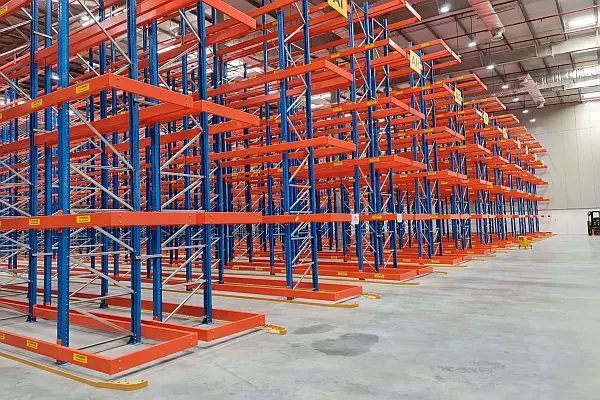
Drive-In racking removes multiple pick aisles by allowing forklifts to enter lanes to place and retrieve pallets. It is typically used for storing large quantities of the same product type and often follows the First-In-Last-Out principle.
Where Drive-In fits best
Drive-In is a strong fit for seasonal products, buffer stock, and uniform pallet loads where FILO matches your operational rules.
Pallet Shuttle systems for faster lanes and improved handling
Shuttle-style systems use a semi-automated platform that moves within the racking structure to place and retrieve pallets. This can improve handling speed and reduce the need for forklifts to travel deep into lanes, which is useful for both safety and throughput.
Why food and beverage sites choose shuttle systems
They are often selected when operations want high density but also want better picking rates than traditional deep-lane approaches. Shuttle systems can be configured to support FILO and, in many designs, FIFO principles depending on lane arrangement.
Temperature range and finish considerations
Bulk storage is commonly used in cold environments where footprint cost is high. Systems specified for food and beverage often need to operate from -30°C to +40°C across frozen, chilled, and ambient areas. Galvanized finishes are commonly chosen to help prevent rust, especially where condensation is expected.
How to choose between Drive-In and Shuttle
Choose Drive-In when
You store large quantities of the same SKU, FILO is acceptable, and you want maximum density with straightforward equipment requirements.
Choose Shuttle when
You want high density but need faster loading and retrieval, reduced forklift entry into lanes, and improved performance under high throughput conditions.
How LinkMisr tailors bulk storage for food and drink
Bulk systems work best when lane depth, pallet quality, handling equipment, and dispatch rhythm are planned together. LinkMisr typically reviews SKU blocks, peak season requirements, inbound batch sizes, and cold room constraints, then proposes a design that increases capacity while keeping product handling controlled and predictable.
FAQ
Is Drive-In racking suitable for mixed SKUs?
It is usually best for large quantities of the same SKU or similar pallets. Mixed SKU environments often need more selectivity than Drive-In provides.
Does a Pallet Shuttle reduce forklift travel?
Yes. The shuttle performs pallet movement inside lanes, reducing deep forklift entry and improving handling efficiency in many layouts.
Can bulk storage be used in frozen warehouses?
Yes. Many bulk systems are designed to operate in harsh environments down to -30°C when specified correctly for cold-store use.
What rotation method does Drive-In use?
Drive-In commonly follows FILO. If you require strict FIFO, consider flow systems or FIFO-capable shuttle configurations depending on your operation.
How does bulk storage save money in cold rooms?
By increasing storage density, you can reduce the cold footprint needed for the same stock level, which can lower cooling costs and free space for staging and dispatch.
What products in food and beverage benefit most from bulk systems?
Beverages, ingredients, seasonal promotions, and any product family with high volume and consistent pallet formats often benefit from bulk storage.
Get a bulk storage layout built for your operation
If you need to increase pallet capacity without expanding your warehouse, LinkMisr can design a Drive-In or Pallet Shuttle solution that matches your SKU blocks, temperature zones, and throughput targets.